Curing Process in Concrete: Why It Matters for Strong and Durable Homes in Gurgaon
When homeowners think about concrete construction, they usually focus on the cement, steel, concrete grade and reinforcement.
But there is another important step that happens after concrete is placed.
It is called curing.
Curing is an essential part of concrete construction because it helps provide suitable conditions for cement hydration and the development of the concrete’s intended properties.
From foundations and columns to beams, slabs and other RCC elements, proper curing should be treated as an important part of the construction process.
For homeowners planning house construction in Gurgaon or Gurugram, understanding the curing process can help them recognize an important quality-control stage that is often hidden behind the finished walls and finishes.
💧 What Is Curing in Concrete?
Curing is the process of maintaining suitable moisture and temperature conditions in concrete after placement so that cement hydration can continue and the concrete can develop its required properties.
In simple terms:
Concrete Placement
↓
Moisture + Suitable Conditions
↓
Cement Hydration
↓
Strength & Durability Development
Concrete does not achieve its intended properties simply because it has been poured into a beam, column or slab.
The conditions after placement also matter.
Why Is the Curing Process Important?
Concrete contains cement, water and aggregates.
When cement reacts with water, a chemical process called hydration takes place.
This process contributes to the development of the hardened cement matrix.
If concrete loses moisture too quickly, the conditions needed for proper hydration can be affected.
Proper curing can help:
- 💪 Support strength development
- 🛡️ Improve durability
- 💧 Reduce excessive moisture loss
- 🧱 Reduce the risk of certain shrinkage-related problems
- 🌡️ Control the effects of environmental conditions
- 🏗️ Support the intended performance of concrete
Curing therefore isn’t an optional finishing activity.
It is part of concrete construction.
Curing Is Not the Same as Simply Pouring Water
This is an important point for homeowners.
You may see workers applying water to concrete and assume that curing is simply about keeping everything wet.
It is more accurate to think of curing as maintaining appropriate conditions for concrete to develop its intended properties.
Depending on the concrete element, weather and construction method, curing can involve different techniques.
The objective is to prevent excessive moisture loss and maintain suitable conditions for hydration.
Where Is Curing Required in a House?
Curing can be relevant to many cement-based and concrete elements.
| Construction Element | Why Curing Matters |
| Foundation | Supports concrete strength development |
| Footings | Important for structural concrete |
| Columns | Supports development of concrete properties |
| Beams | Important for RCC structural elements |
| Slabs | Helps concrete develop intended properties |
| Staircases | Important for reinforced concrete |
| Concrete walls | Helps support proper hydration |
| Masonry work | Appropriate curing may be required depending on materials |
| Plaster | Curing requirements depend on the plaster system |
The exact method and duration should be determined according to the material, construction specification, environmental conditions and applicable requirements.
🏗️ Curing Process for Different RCC Elements
1. Foundation Curing
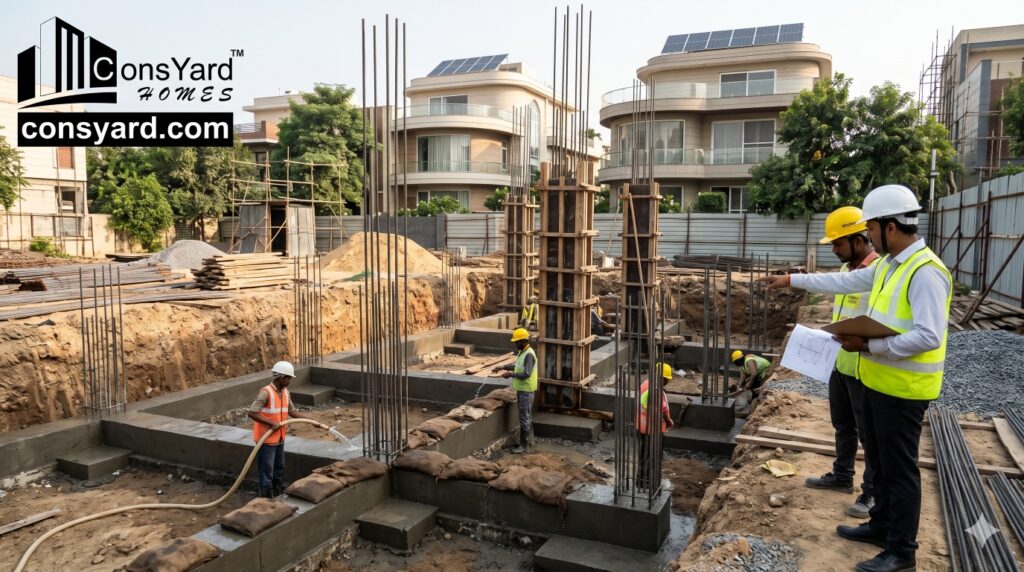
Foundations are among the first major structural elements constructed.
After foundation concrete is placed and has reached the appropriate stage, curing is carried out according to the specified procedure.
Good foundation construction involves more than:
Excavation → Steel → Concrete
It also includes:
Concrete → Proper Curing → Inspection → Next Stage
2. Column Curing
Columns are vertical structural members that form part of the RCC framework.
After concrete placement and appropriate initial setting, curing is carried out to maintain suitable conditions.
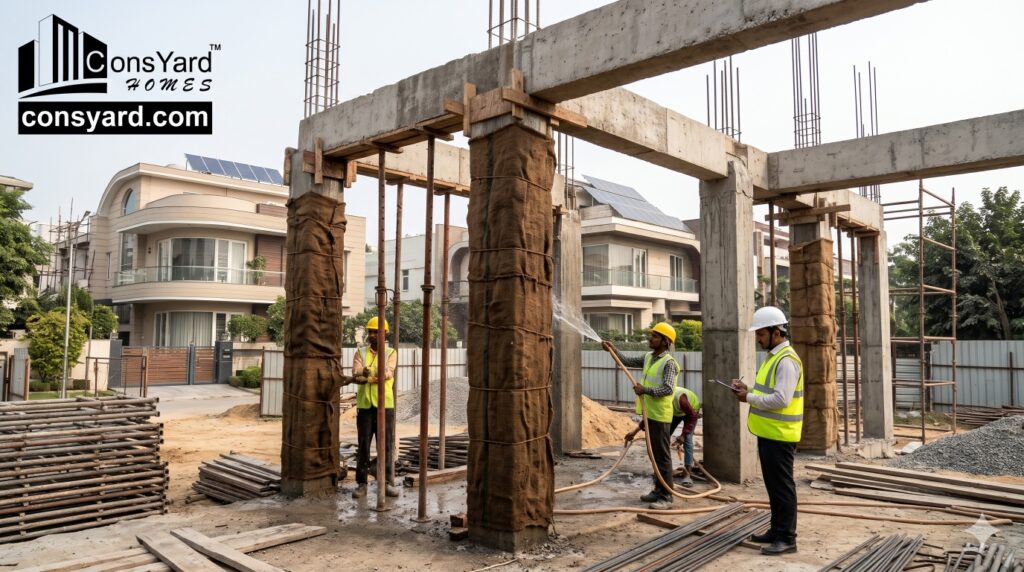
Depending on the construction method, this may involve keeping the surface moist or using another approved curing method.
3. Beam Curing
Beams are important structural members that transfer loads according to the building’s structural design.
After beam concrete is placed, appropriate curing helps support the development of the concrete’s intended properties.
Because beams can be exposed to hot and dry conditions during construction, site teams need to pay attention to moisture loss.
4. Slab Curing
Roof and floor slabs have relatively large surface areas.
This makes moisture management particularly important.
Depending on the construction method, curing may involve techniques such as:
- Ponding
- Wet coverings
- Regular water application
- Membrane curing
- Other approved curing systems
The appropriate method depends on the project.
🌡️ Why Gurgaon Weather Matters During Concrete Curing
Gurgaon and Gurugram experience significant seasonal changes.
Construction may take place during:
☀️ Hot summer conditions
🌧️ Monsoon humidity and rainfall
❄️ Cooler winter temperatures
Environmental conditions can affect the rate at which concrete loses moisture.
During hot, dry or windy weather, exposed concrete surfaces may lose moisture quickly.
During monsoon conditions, the challenge can be different because rain, drainage and site access need to be managed.
A professional construction team should adapt its curing and concrete-management practices to actual site conditions.
Curing During Summer Construction in Gurgaon
Hot weather can increase the rate of evaporation from freshly placed concrete.
This can create challenges if the concrete surface dries too quickly.
Construction teams may need to pay particular attention to:
- Timing
- Surface protection
- Moisture retention
- Curing arrangements
- Water availability
- Concrete temperature
- Weather conditions
The objective is to prevent uncontrolled moisture loss.
Curing During Monsoon
Monsoon conditions create a different set of challenges.
Heavy rainfall can affect:
- Fresh concrete
- Site access
- Water management
- Excavations
- Material storage
- Curing arrangements
Rainwater should not simply be assumed to provide proper curing.
The concrete still needs an appropriate curing strategy.
Curing During Winter
Cooler conditions can affect the rate of cement hydration.
Construction teams should consider:
- Ambient temperature
- Concrete temperature
- Moisture retention
- Protection requirements
- Construction schedule
The curing procedure should be appropriate for the actual conditions rather than following the same routine regardless of weather.
💧 Common Methods of Concrete Curing
Different curing methods can be used depending on the project.
1. Water Curing
Water is supplied to maintain moisture at the concrete surface.
Common techniques can include:
- Ponding
- Sprinkling
- Wet coverings
2. Wet Coverings
Materials such as wet hessian/burlap or other suitable coverings can help retain moisture.
3. Membrane Curing
A suitable curing compound or membrane system can be used to reduce moisture loss where appropriate.
4. Ponding
For suitable horizontal surfaces, water can be retained on the slab to maintain moisture.
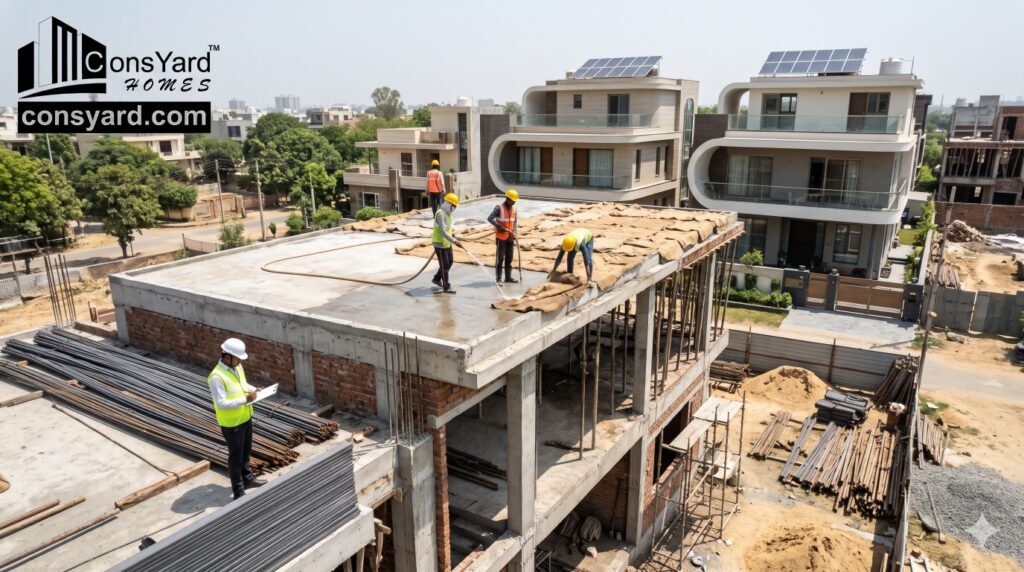
Curing Method Comparison
| Method | Common Application | Main Purpose |
| Ponding | Suitable horizontal surfaces | Maintains moisture |
| Sprinkling | Suitable surfaces | Provides moisture |
| Wet coverings | Beams, slabs and other surfaces | Helps retain moisture |
| Curing compounds | Where specified | Reduces moisture loss |
| Other approved methods | Project-specific | Maintains suitable curing conditions |
Not every method is appropriate for every construction element.
How Long Should Concrete Be Cured?
This is one of the most common questions homeowners ask.
There is no single number that should automatically be applied to every concrete situation.
Curing requirements depend on factors such as:
- Cement type
- Concrete mix
- Structural element
- Weather
- Temperature
- Humidity
- Construction method
- Applicable standards
- Project specification
Therefore, curing should follow the applicable project specification and relevant standards rather than a generic rule copied from another construction site.
Does More Curing Always Mean Stronger Concrete?
Proper curing is beneficial, but construction should follow the specified curing regime rather than assuming that continuously adding water indefinitely will always improve the concrete.
Concrete performance depends on many factors:
Materials
Mix Design
Water-Cement Ratio
Placement
Compaction
Curing
Environmental Conditions
All of these factors work together.
Curing and Water-Cement Ratio
The water-cement ratio is another important part of concrete technology.
A simplified formula is:
Water-Cement Ratio = Weight of Water ÷ Weight of Cement
Adding uncontrolled extra water to concrete can alter the specified mix and potentially affect its properties.
Curing is different.
Curing aims to retain or maintain suitable moisture conditions after concrete placement.
These are two separate concepts.
Curing vs Adding Water to Fresh Concrete
| Curing | Adding Extra Water to Fresh Concrete |
| Happens after appropriate concrete placement | Happens during concrete mixing/handling |
| Maintains suitable moisture conditions | Changes the concrete mix |
| Supports cement hydration | Can alter the designed water-cement ratio |
| Part of the construction process | Should not be done casually |
| Controlled according to specification | Uncontrolled addition can be problematic |
This distinction is important when monitoring residential construction.
What Happens If Concrete Is Not Cured Properly?
Inadequate curing can contribute to:
- Reduced strength development
- Increased surface drying
- Shrinkage-related cracking
- Reduced durability
- Poor surface quality
- Greater susceptibility to certain environmental effects
The actual impact depends on the concrete, exposure, curing conditions and severity of the problem.
This is why curing should not be treated as a minor site activity.
🧱 Curing and Concrete Cracks
Cracks in concrete can have different causes.
They may be associated with factors such as:
- Shrinkage
- Thermal movement
- Settlement
- Structural loading
- Poor detailing
- Improper construction practices
- Excessive moisture loss
Therefore, every crack should not automatically be blamed on poor curing.
However, appropriate curing can help reduce certain risks associated with excessive moisture loss and shrinkage.
If a significant structural crack appears, it should be evaluated by a qualified professional.
Curing and Honeycombing
Honeycombing is generally associated with problems such as:
- Poor compaction
- Inadequate concrete placement
- Congested reinforcement
- Formwork issues
- Concrete segregation
It is not simply a curing problem.
This distinction matters because applying water to a honeycombed area does not fix the underlying defect.
Significant concrete defects should be assessed and repaired according to an appropriate technical procedure.
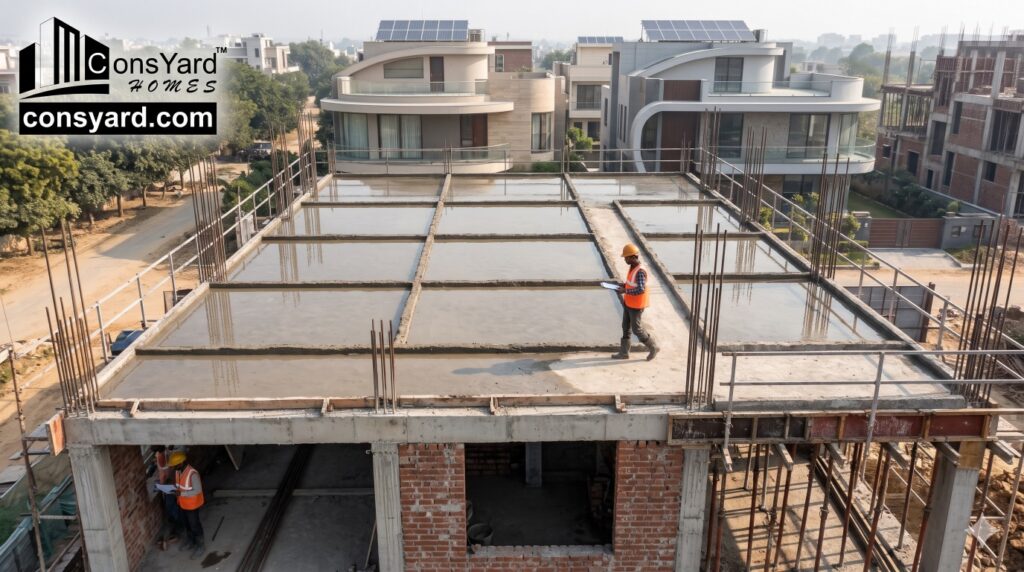
Curing Process: Step-by-Step
A simplified curing workflow can be understood as:
🏗️ Step 1: Concrete Placement
Concrete is placed according to the construction procedure.
🔩 Step 2: Compaction
Concrete is properly consolidated.
⏱️ Step 3: Initial Protection
The concrete is protected during the early stage as required.
💧 Step 4: Curing Begins
An appropriate curing method is started at the correct stage.
🌡️ Step 5: Conditions Are Maintained
Moisture and temperature conditions are managed according to the specification.
🔍 Step 6: Inspection
The construction team monitors the condition of the concrete.
🏠 Step 7: Continue Construction
The next construction activity proceeds when the required conditions are met.
Curing Process for a House: Complete Construction Flow
A residential RCC project may broadly progress as:
Foundation
↓ 💧 Curing
Columns
↓ 💧 Curing
Beams
↓ 💧 Curing
Slab
↓ 💧 Curing
Masonry
↓ 💧 Curing Where Applicable
Plaster
↓ 💧 Curing Where Applicable
Finishing
This shows why curing is repeated throughout the construction process.
Curing Quality Checklist for Homeowners
You don’t need to supervise the workers personally, but you can understand the major checkpoints.
| Checkpoint | What to Look For |
| Concrete placement | Properly executed |
| Initial protection | Concrete protected appropriately |
| Curing method | Suitable for the element |
| Moisture | Surface maintained appropriately |
| Weather | Summer/monsoon conditions considered |
| Duration | Follows project specification |
| Coverage | Relevant concrete surfaces addressed |
| Inspection | Curing monitored |
| Documentation | Relevant records maintained |
🚫 Common Curing Mistakes
1. Starting Curing at the Wrong Time
Curing should begin at an appropriate stage for the concrete and method being used.
2. Allowing Concrete to Dry Out
Freshly placed concrete can lose moisture rapidly under hot or windy conditions.
3. Assuming Rain Is Enough
Rainfall does not automatically replace a planned curing process.
4. Ignoring Vertical Elements
Columns and vertical concrete surfaces also require appropriate curing.
5. Applying Water Randomly
Curing should follow an appropriate method rather than simply spraying water occasionally.
6. Stopping Too Early
The curing regime should follow the project requirements.
7. Ignoring Weather
Hot, dry and windy conditions can increase evaporation.
Curing Process in Concrete: Professional vs Uncontrolled Approach
| Controlled Approach | Uncontrolled Approach |
| Curing method is planned | Workers decide casually |
| Weather considered | Weather ignored |
| Relevant surfaces identified | Only easily accessible surfaces treated |
| Appropriate timing | Irregular timing |
| Monitoring | No monitoring |
| Specification followed | Generic assumptions |
| Issues documented | Problems discovered later |
This is one reason why organized residential construction in Gurgaon can provide better control over construction activities.
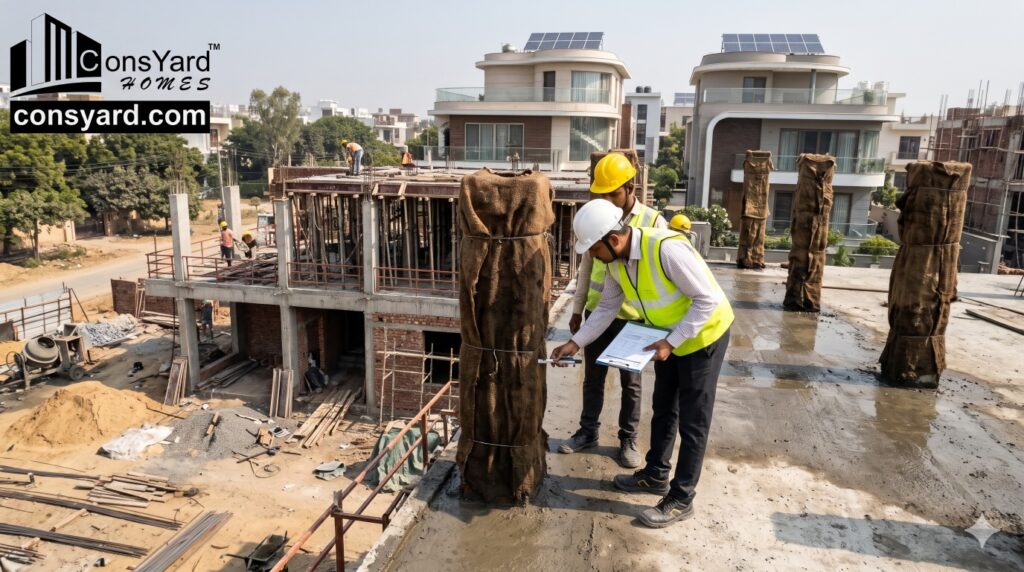
How Curing Fits Into Overall Concrete Quality
It is important not to isolate curing from the rest of the concrete process.
A better way to look at concrete quality is:
1️⃣ Material Quality
Cement, aggregates, water and other specified materials.
2️⃣ Mix Design
Correct proportions and concrete specification.
3️⃣ Reinforcement
Correct steel placement and detailing.
4️⃣ Formwork
Correct dimensions, alignment and stability.
5️⃣ Placement
Proper handling and placement of concrete.
6️⃣ Compaction
Appropriate consolidation.
7️⃣ Curing
Suitable moisture and temperature conditions.
8️⃣ Inspection
Quality checks throughout the process.
All eight stages contribute to the final result.
Curing and Structural Safety
Curing is important for concrete performance, but structural safety is much broader.
A home’s structural safety depends on:
🏗️ Foundation design
📐 Structural engineering
🔩 Reinforcement
🧱 Concrete
📏 Correct dimensions
💧 Curing
👷 Workmanship
🔍 Inspection
No single factor can guarantee structural safety by itself.
Curing During Different Construction Stages
| Stage | Curing Consideration |
| Foundation | Maintain appropriate moisture after placement |
| Column | Protect vertical concrete surfaces |
| Beam | Maintain suitable conditions |
| Slab | Manage moisture across large exposed surfaces |
| Staircase | Follow appropriate curing procedure |
| Masonry | Follow material-specific requirements |
| Plaster | Cure according to plaster system/specification |
The exact procedure should be determined by the construction specification and material requirements.
How Consyard Homes Approaches Concrete Work
At Consyard Homes, concrete construction is treated as part of a structured residential construction process.
The overall workflow can include:
📐 Architectural Planning
🏗️ Structural Design
⛏️ Foundation Construction
🔩 Reinforcement
🧱 RCC Structure
💧 Concrete Curing
🧱 Masonry
🚰 Plumbing
⚡ Electrical
🛡️ Waterproofing
🎨 Finishing
🔑 Handover
With 25+ years of experience and 500+ completed projects, Consyard Homes works with homeowners in Gurgaon, Gurugram, Manesar and selected areas of Delhi NCR.
The focus is on coordinating engineering, materials, workmanship and site execution throughout the project.
Why Homeowners Should Pay Attention to Curing
Curing is one of those construction activities that receives very little attention once the finished house is complete.
You won’t see curing when you look at:
- Your living room
- Bedroom
- Kitchen
- Exterior elevation
- Flooring
But it happens during the stage when the structural concrete is developing its properties.
That makes it a good example of an important construction activity that is invisible in the finished home but significant during execution.
🏠 A Simple Way to Think About Curing
Think of concrete construction as a process rather than a single event.
Good Cement
Good Aggregates
Correct Mix
Correct Reinforcement
Proper Placement
Proper Compaction
Proper Curing
=
Better Concrete Construction
Removing any one part from the process can affect the overall result.
Frequently Asked Questions About Concrete Curing
What is the curing process in concrete?
Curing is the process of maintaining suitable moisture and temperature conditions in concrete after placement so that cement hydration can continue and the concrete can develop its intended properties.
Why is curing important for house construction?
It supports strength development and durability and helps control moisture loss from concrete.
How long should concrete be cured?
There is no single duration applicable to every situation. Requirements depend on the concrete, cement type, weather, construction method, applicable standards and project specifications.
Can rain replace concrete curing?
Not necessarily. Rainfall does not automatically provide controlled curing conditions.
Is curing required for columns?
Yes, appropriate curing is required for reinforced concrete columns and other structural concrete elements.
Is curing required for slabs?
Yes. Slabs have large exposed surfaces and require an appropriate curing strategy.
Can poor curing cause cracks?
Inadequate curing can contribute to certain shrinkage-related cracking risks, but concrete cracks can have many different causes.
Does curing make concrete stronger?
Proper curing supports the development of the concrete’s intended properties. It should be considered alongside correct materials, mix design, placement and compaction.
Is curing required in Gurgaon during winter?
Concrete still requires an appropriate curing regime during winter. The method should account for actual temperature and environmental conditions.
Who should decide the curing method?
The construction method should follow the project’s specifications, applicable standards and guidance from the responsible technical professionals.
Final Thoughts
The curing process in concrete may look simple from the outside, but it plays an important role in residential construction.
Concrete quality is not determined only when the concrete truck arrives at the site.
It develops through a chain of activities:
Material Selection
↓
Mixing
↓
Placement
↓
Compaction
↓
Curing
↓
Strength & Durability Development
For homeowners planning house construction in Gurgaon, Gurugram or Manesar, understanding these stages can help you recognize the difference between simply completing construction work and following a controlled construction process.
At Consyard Homes, we believe that quality is built into the process, from foundation and RCC structure to waterproofing, finishing and final handover.
Don’t Let Rushed Curing Weaken Your Home’s Concrete Strength
Even the finest M25/M30 concrete and Fe-550D steel lose durability if moisture evaporates too fast in Gurgaon’s extreme weather. For Stilt + 3 and Stilt + 4 homes across Gurgaon, Manesar, and Delhi NCR, Consyard Homes enforces a strict 21-day continuous slab curing protocol and Seismic Zone 4 engineering supervision—starting at ₹940/sq. ft. for grey structure.