Ever wondered what holds a modern building together, allowing it to withstand earthquakes, heavy loads, and the test of time? The answer often lies in the steel reinforcement inside the concrete, and today, the star of that show is the TMT bar. But with terms like TMX, various grades, and primary vs. secondary steel floating around, things can get confusing. Let’s break it all down.
TMT vs. TMX Bars: What’s the Difference?
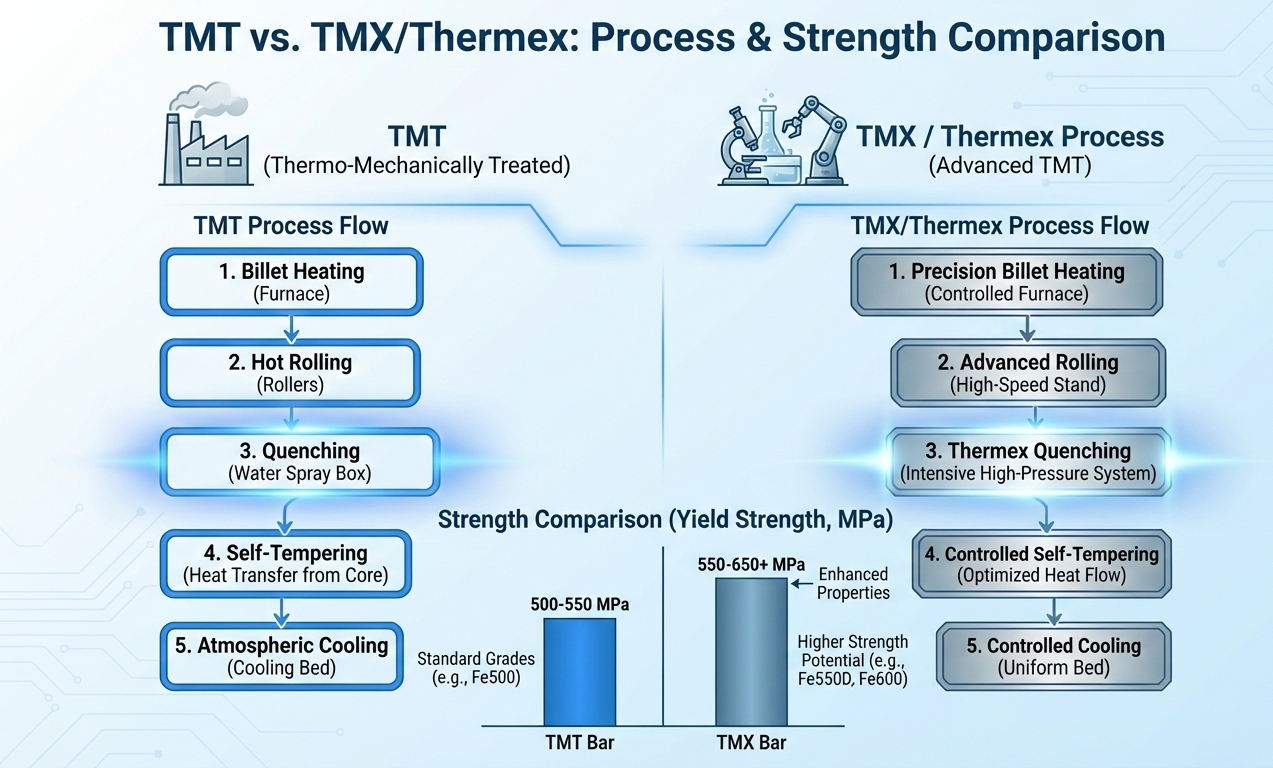
You might hear both terms, but they aren’t quite the same thing.
Quick Help Before You Buy Steel
Not sure whether to use Fe 500 or Fe 500D for your construction? Speak to Consyard Homes for quick guidance and cost estimation support.
- TMT Bars (Thermo-Mechanically Treated): This is the general category for bars made through a process of controlled heating and rapid cooling. The most common technology used is called “Tempcore.” This process gives the bars a hard outer layer and a soft, ductile inner core.
- TMX Bars (Thermex): Think of TMX as a specific, branded type of TMT bar. It uses the “Thermex” technology, another patented quenching process. These bars are often noted for excellent tensile strength, flexibility, and a rib pattern that creates a superior bond with concrete.
In simple terms: All TMX bars are TMT bars, but not all TMT bars are TMX. TMX is often specified for critical, large-scale projects like skyscrapers, long bridges, and dams where maximum performance is non-negotiable. For most residential and commercial buildings, high-quality standard TMT bars are perfectly suitable.
What Exactly Are TMT Steel Bars?
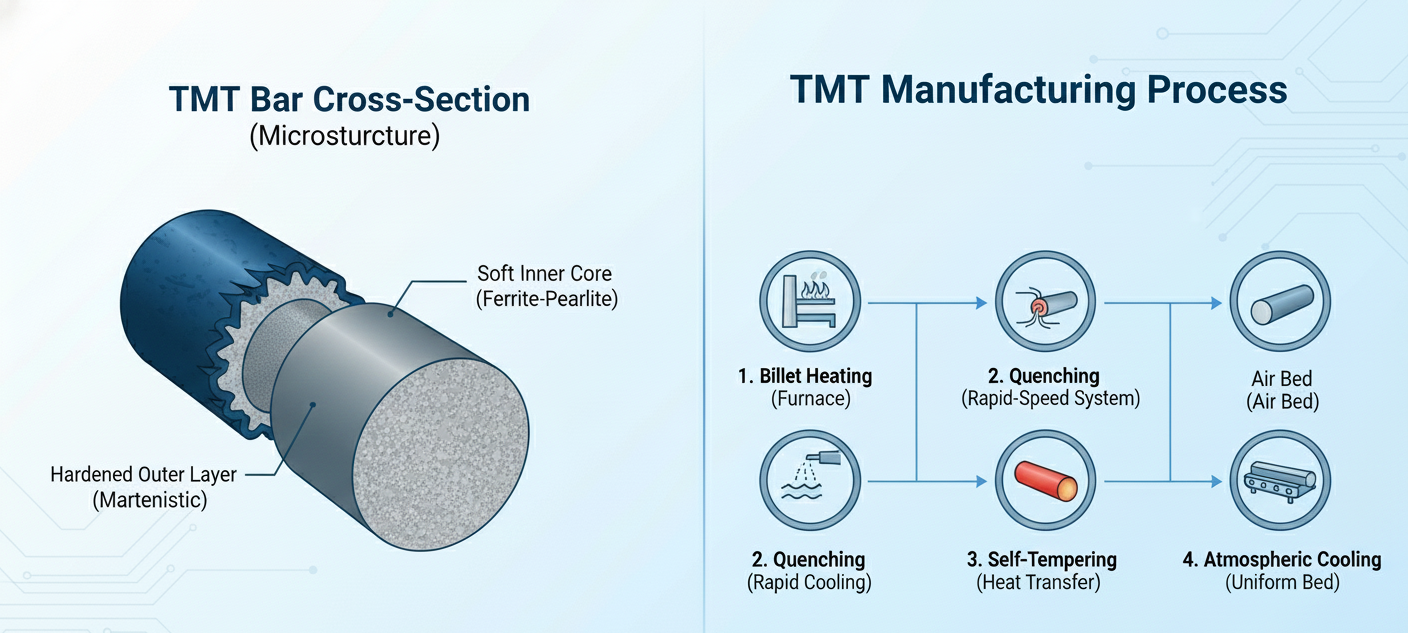
A TMT bar is a high-strength steel rod used to reinforce concrete. Its special strength comes from its unique manufacturing. The steel is heated and then suddenly cooled with water jets (quenching), forming a hard outer “martensite” layer. It is then cooled naturally in air, leaving a softer, more flexible ferrite-pearlite core.
This “hard shell, soft core” combination is the magic. It gives the bar incredible strength to bear loads while remaining flexible enough to bend without snapping—a crucial feature for earthquake resistance.
Key Properties: Why Choose TMT Bars?
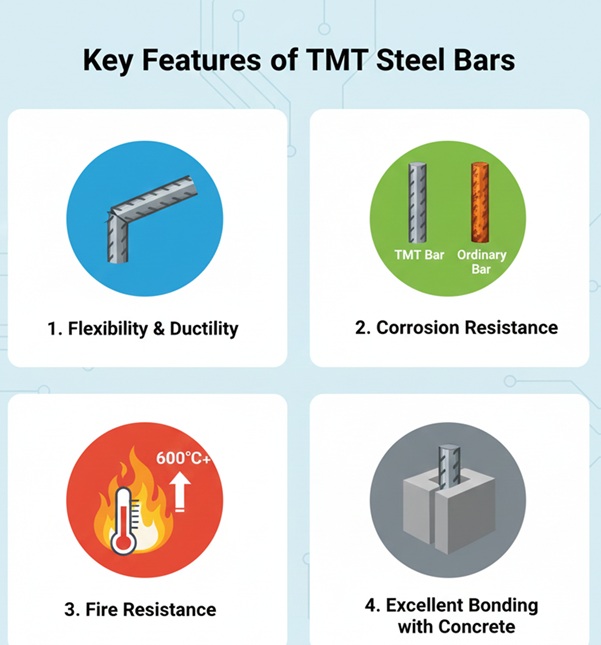
- Ductility & Strength: The perfect balance. The soft core allows it to absorb seismic energy and deform slightly under stress, while the hard outer shell provides the strength to hold the structure up.
- Corrosion Resistance: The quenching process and the composition make these bars highly resistant to rust, which protects the concrete from cracking and spalling over decades.
- Fire Resistance: They retain more of their strength at high temperatures compared to older types of steel, buying crucial time in case of a fire.
- Superior Bonding: Their surface rib pattern is designed to grip concrete tightly, preventing slippage and ensuring the steel and concrete work as one solid unit.
Where Are TMT Bars Used?
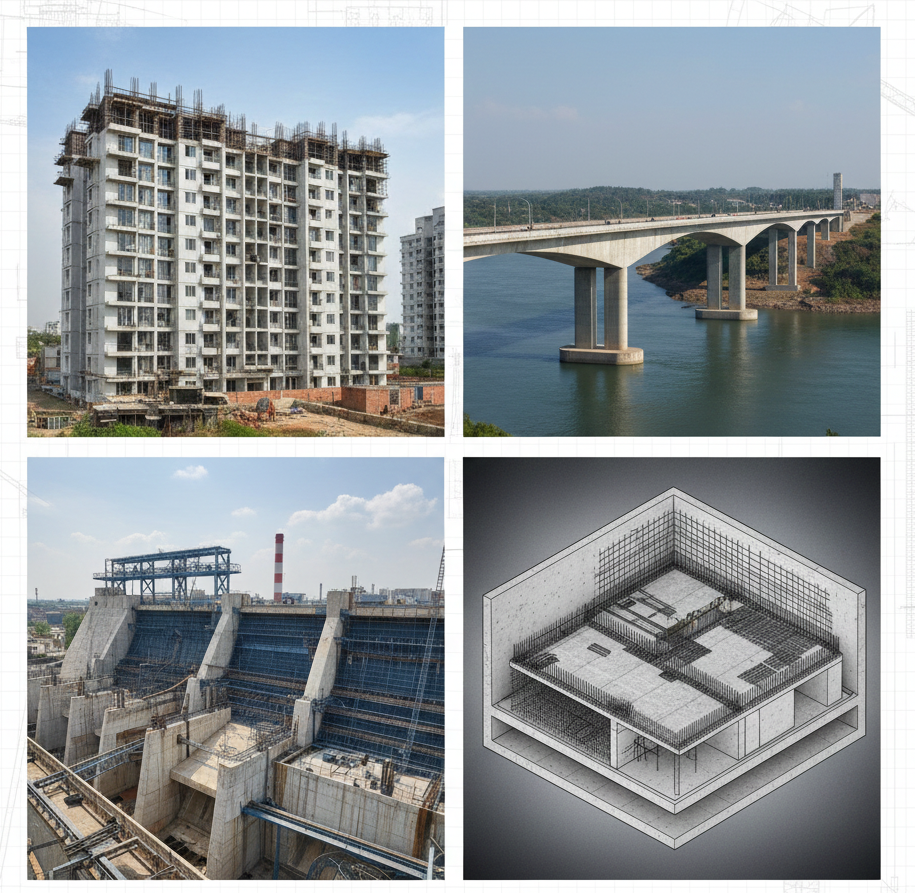
Essentially, anywhere you need reinforced concrete:
- Houses, apartments, and office buildings.
- Bridges, flyovers, and metro stations.
- Dams, power plants, and industrial facilities.
- Foundations, basements, and other underground structures.
Understanding TMT Bar Grades: Fe 500, Fe 500D, etc.
The grade tells you the bar’s minimum yield strength and ductility.
- Fe: Stands for Ferrum, the Latin word for iron.
- Number (500, 550, etc.): The minimum yield strength in Megapascals (MPa). A Fe 500 bar can withstand a stress of 500 N/mm² before it starts to deform permanently.
- Letter D: Stands for Ductility. Bars with a ‘D’ (like Fe 500D) have higher elongation, meaning they can stretch more before breaking. This is vital for earthquake-prone areas.
A Quick Guide to Common Grades:
- Fe 415: Economical, with good flexibility. Used in small-scale residential projects.
- Fe 500: The industry standard. Offers high strength for most RCC work in houses, medium-rise buildings, and bridges.
- Fe 500D: Same strength as Fe 500, but with higher ductility. Highly recommended for seismic zones. Very common today.
- Fe 550/Fe 550D: Higher strength for larger projects like industrial structures or high-rises. The ‘D’ variant again offers better earthquake resistance.
- Fe 600: The strongest grade. Used in heavy-duty infrastructure like large dams, long-span bridges, and ports, where reducing the amount of steel used is a priority.
For most low and mid-rise buildings, Fe 500, Fe 500D, Fe 550, or Fe 550D are excellent and commonly used choices.
Primary vs. Secondary Steel: Which One?
This is a common point of discussion.
- Primary Steel: Made from virgin iron ore in an integrated steel plant.
- Secondary Steel: Made by melting recycled scrap metal in an electric arc furnace.
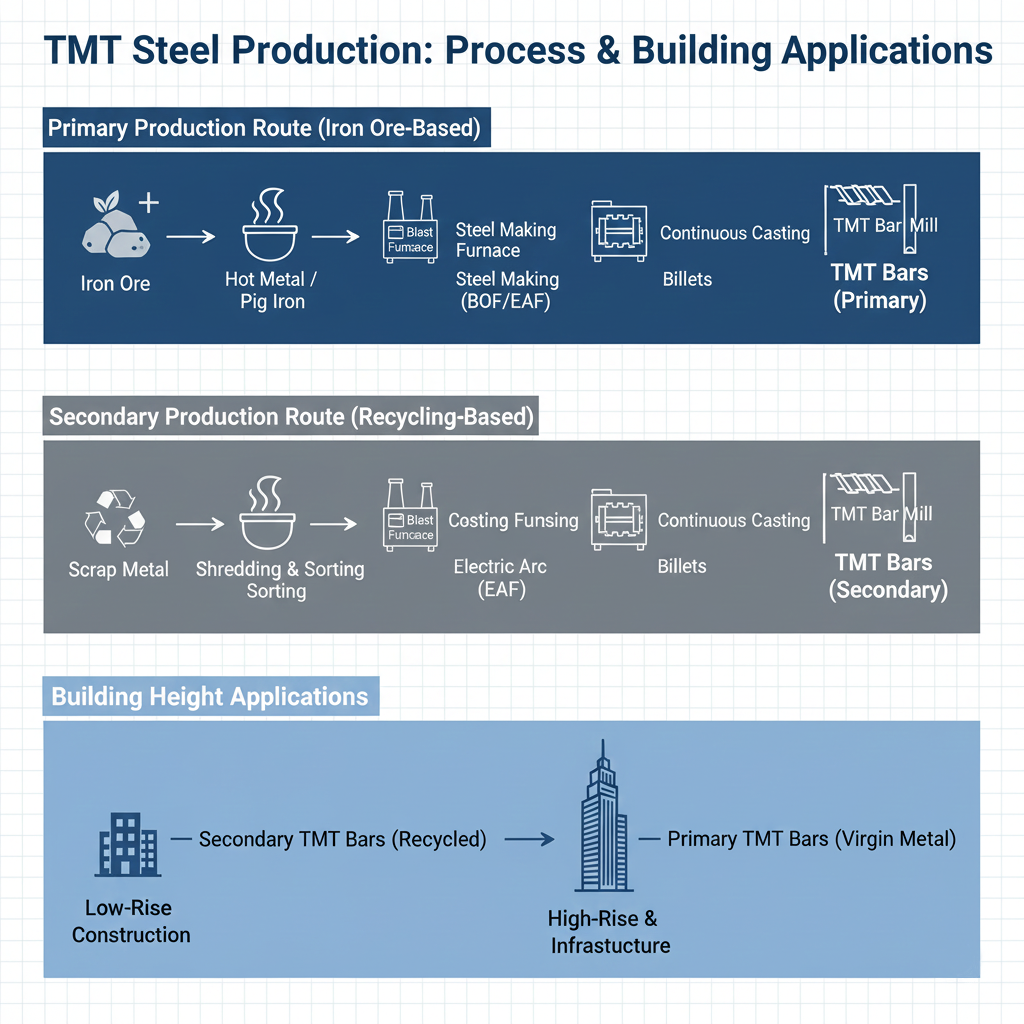
Which should you use? The most important factor is consistent, certified quality, regardless of the type. However, as a general rule of thumb:
- High-rise buildings: Definitely opt for certified primary steel for its assured homogeneity and strength.
- Mid-rise buildings: Primary steel is the first preference. Good quality secondary steel from a reputed brand can also be used.
- Low-rise buildings (e.g., individual homes): Quality-certified secondary steel is sufficient. If your budget allows, primary steel is a great choice for added assurance.
Sizes, Lengths, and Weights
Available Sizes: Diameters range from 6mm to 50mm. The most commonly used sizes in housing are 8mm, 10mm, 12mm, 16mm, 20mm, and 25mm.
Standard Length: Almost universally 12 meters (about 40 feet). This ensures uniformity on site.
Calculating Weight: The weight is crucial for estimating costs. You can use this simple formula:
Weight per meter (kg) = (Diameter x Diameter) / 162
(Where diameter is in millimeters)
Weight Chart (for standard 12m length):
The weight of various thickness is as under: –
| Thickness (mm) | Weight per meter (kg) | Weight per length of 12 meters (kg) |
| 6 | 0.222 | 2.667 |
| 8 | 0.395 | 4.741 |
| 10 | 0.617 | 7.407 |
| 12 | 0.889 | 10.667 |
| 16 | 1.580 | 18.963 |
| 20 | 2.469 | 29.630 |
| 25 | 3.858 | 46.296 |
| 32 | 6.321 | 75.852 |
Need help choosing the right TMT steel for your project?
Whether you’re selecting Fe 500 vs Fe 500D or estimating steel quantity for RCC work, our team can guide you based on your building type, budget, and site conditions.
Golf Course Extension Road, Gurugram, Haryana 12201