
For sophisticated plot owners in Delhi, Gurugram, and Noida, selecting the right execution framework is the single most critical financial decision of the pre-construction phase. When moving past basic masonry into premium, high-spec custom residential projects, traditional self-sourcing models fall short. This leaves property owners weighing two professional options: executing via a premium turnkey firm or hiring a house construction manager through a Project Management Consultancy (PMC).
Both frameworks claim to optimize delivery, but they approach cost management, supply chain vulnerability, and engineering accountability from opposing operational philosophies. Evaluating turnkey construction vs PMC India dynamics reveals the hidden operational layers that dictate whether a high-ticket residential asset finishes within budget or spirals into severe financial overruns.
Understanding the Frameworks: Turnkey vs. PMC
The core distinction between the two approaches centers around risk distribution and contractual consolidation:
- The Turnkey Model: Consolidates architectural design, regulatory clearance, structural engineering, procurement, and site execution under a single contract. The turnkey contractor bears single-point financial responsibility for delivery, matching a strictly itemized scope to a legally locked price agreement.
- The PMC Model: Functions purely as an independent consultant acting as your representative on-site. The PMC supervises material quality, schedules, and billing variations, but the homeowner remains the primary party signing contracts with individual civil, electrical, plumbing, and finishing contractors.
The Hidden Costs of Managing Fragmented Vendors
Advocates of the PMC framework often emphasize cost-plus contract benefits, pointing to the structural transparency of reviewing separate vendor bids and material procurement invoices directly. On paper, bypassing a general contractor’s margin appears cost-effective. However, in the highly volatile Delhi-NCR market, this assumption frequently collapses under execution realities.
When you opt for a PMC, your budget is exposed to multiple points of vulnerability:
- Inter-Vendor Conflict and Rework: If a structural slab develops alignment anomalies, the civil vendor blames the formwork team, while the finishing team demands extra compensation to correct the masonry error with thicker plaster. While a PMC identifies these mistakes, the financial liability for fixing the error remains with the homeowner. In a turnkey model, these internal mismatches are absorbed entirely by the principal firm.
- NCR Supply Chain and Sourcing Inefficiencies: Individual homeowners do not have the institutional procurement volume to negotiate high-tier trade discounts on premium raw materials like Tata Tiscon steel or structural grade aggregates. Turnkey firms utilize institutional purchasing volumes across multiple concurrent sites in Delhi-NCR, allowing them to secure price-locks that offset sudden market spikes.
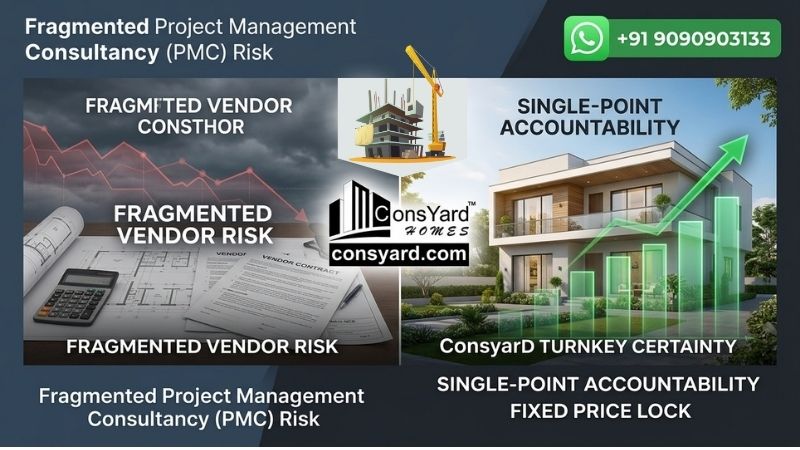
Turnkey vs. PMC: Direct Structural Comparison
| Financial Metric | Project Management Consultancy (PMC) | Consyard Turnkey Execution |
|---|---|---|
| Contractual Structure | Multiple individual contracts with civil, MEP, and finishing labor teams. | Single consolidated contract spanning design to final handover. |
| Price Lock Security | Variable. Vulnerable to market fluctuations and vendor variation claims. | Legally locked per-square-foot price with a Zero Escalation Guarantee. |
| Management Fee Layer | Adds a separate 8% to 15% consultancy fee on top of all raw vendor costs. | Integrated directly within the baseline quote; no secondary fee layers. |
| Liability for Errors | Shared or penal; home owner pays for corrections if vendor disputes occur. | Absolute. The turnkey firm bears 100% financial burden for site corrections. |
Evaluating the Cost-Plus Fee Layer
While the PMC model offers a high degree of daily visual oversight, it introduces a separate, non-productive cost layer: the consultancy fee. A PMC typically charges an extensive percentage of the total construction cost to supervise independent crews. For a premium multi-floor structure or luxury villa in sectors like Golf Course Extension Road or DLF Phase 5, this management fee layer adds lakhs to the budget without supplying any actual physical materials or permanent labor assets.
Furthermore, because a PMC’s compensation is directly linked to total project spending or extended project timelines, there is little structural incentive to cut overall material costs or accelerate the construction lifecycle. Conversely, an established turnkey framework relies on rapid, high-efficiency execution to maintain its corporate margins, aligning its timeline directly with the client’s move-in goal.
Operational Synergy and Engineering Efficiency
Modern architectural structures require precise alignment across several distinct disciplines: structural engineering, HVAC ducting, plumbing layouts, and smart automated electrical pathways. Under a PMC framework, these plans are drawn up by independent consultants and handed to separate execution teams, increasing the risk of design misinterpretation.
At Consyard, we eliminate this friction through integrated engineering. Our architectural, structural, and field execution teams function as a single unit under one roof. When our civil team lays the foundation, they are working off drawings developed in direct coordination with our MEP engineers, ensuring that concealed conduits, waterproofing matrices, and structural load distributions line up exactly without requiring expensive on-site alterations.
Analyze the True Mathematics of Your Build
Don’t let fragmented contracts dilute your construction budget. Download our verified 2026 Cost-Comparison Matrix to contrast turnkey efficiency against PMC fee structures accurately.