Cement Quality in Construction: How to Choose the Right Cement for Your Home
When building a home, people often spend a lot of time thinking about the floor tiles, paint, kitchen, doors and exterior elevation.
But some of the most important decisions happen long before those finishes are visible.
Cement is one of the fundamental materials used throughout residential construction.
It plays an important role in concrete, mortar, plastering and several other construction applications. The quality and suitability of the cement, along with correct storage, proportioning, mixing, placement and curing, can influence the performance of the finished work.
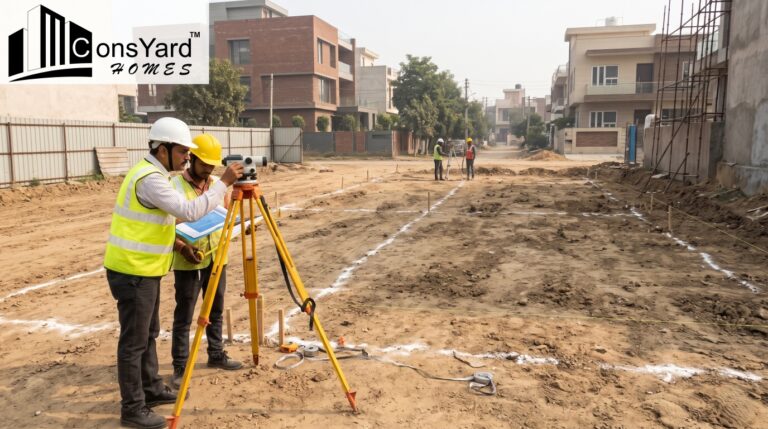
For homeowners planning house construction in Gurgaon or Gurugram, understanding cement quality can help them make better decisions and ask the right questions during construction.
This guide explains what cement quality means, what homeowners should look for, how cement is used at different stages of construction, and why material selection should always be considered together with proper engineering and workmanship.
Why Is Cement Important in Home Construction?
Cement is used in several parts of a residential building.
Depending on the application, it can be involved in:
- Foundation concrete
- Footings
- Columns
- Beams
- Slabs
- Plinth work
- Masonry mortar
- Plastering
- Screeds
- Certain repair and finishing applications
However, cement does not work alone.
Concrete performance depends on the combination of materials and the construction process.
A simplified concrete system is:
Cement + Water + Fine Aggregate + Coarse Aggregate → Concrete
The quality of the final concrete depends on factors such as material quality, proportions, water content, mixing, placement, compaction and curing.
That is why simply buying a premium cement brand does not automatically guarantee a strong structure.
Cement Quality vs Concrete Quality
This is an important distinction that homeowners should understand.
Good cement is important, but good cement alone does not create good concrete.
| Factor | Why It Matters |
| Cement quality | Provides the binding material |
| Aggregate quality | Influences concrete properties |
| Water quality | Can affect concrete performance |
| Mix proportions | Determines the intended concrete composition |
| Water-cement ratio | Influences strength and durability |
| Mixing | Ensures material distribution |
| Compaction | Helps reduce unwanted voids |
| Curing | Allows cement hydration to continue |
| Workmanship | Determines how correctly the material is used |
| Structural design | Defines the required structural system |
This is why structural safety in home construction requires a complete approach rather than focusing on one material alone.
How to Identify Good Quality Cement
Homeowners may not be able to perform laboratory testing at a construction site, but there are practical things they can check.
1. Check the Packaging
Cement bags should be properly packed and identifiable.
Check:
- Manufacturer information
- Cement type/grade
- Relevant standard marking
- Batch or manufacturing information
- Net quantity
- Packaging condition
The exact information available depends on the product and applicable standards.
2. Check the Manufacturing Date
Cement should not be treated like a material that can be stored indefinitely.
As cement ages, its properties can be affected, particularly if it has been exposed to moisture.
When purchasing cement for a project, check the manufacturing information and avoid unnecessarily old stock.
3. Check for Moisture Damage
A cement bag should be dry and properly stored.
If cement has been exposed to moisture, it can develop lumps.
Large or hardened lumps can indicate that the cement has been affected by moisture.
Such material should not simply be used without appropriate evaluation.
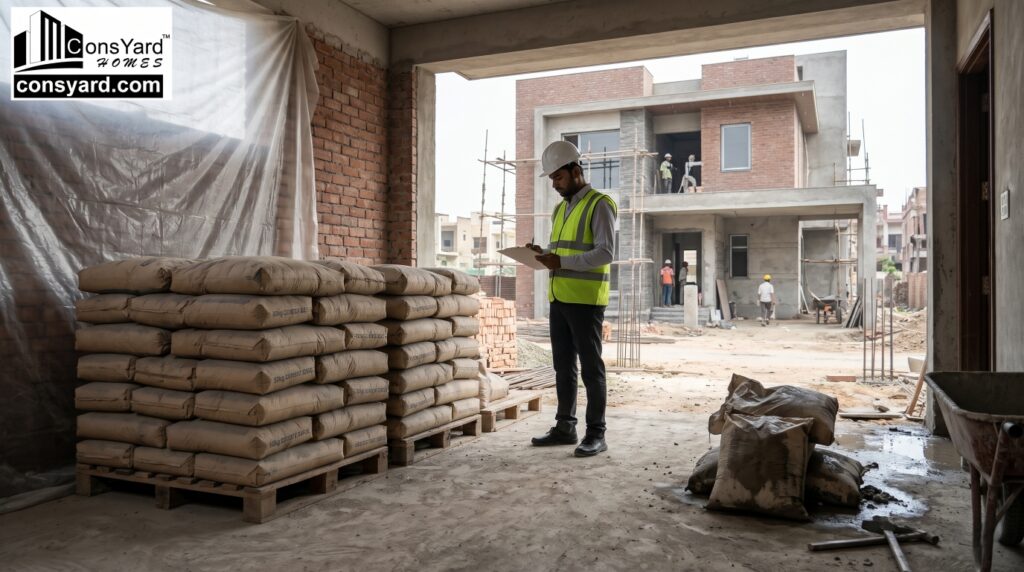
4. Check the Storage Conditions
Even good-quality cement can be compromised by poor storage.
Cement should be protected from:
- Rain
- Ground moisture
- Damp walls
- Excess humidity
- Direct exposure to water
Proper storage is particularly important during residential construction where materials may remain on-site for different periods.
How Should Cement Be Stored at a Construction Site?
Proper storage is an important part of material management.
Cement bags should generally be kept:
- In a dry location
- Protected from rain
- Away from direct ground contact
- On a suitable raised platform
- Protected from moisture
- In an organized stack
The storage arrangement should also allow older stock to be used appropriately rather than leaving older bags buried beneath newer deliveries.
Good Storage vs Poor Storage
| Good Storage | Poor Storage |
| Dry enclosed area | Open exposure |
| Raised from ground | Directly on floor/ground |
| Protected from water | Rain or moisture exposure |
| Organized stock | Random stacking |
| Controlled usage | Long uncontrolled storage |
| Regular inspection | No material checks |
Material storage may look like a small site-management issue, but it can affect the quality of the material eventually used in the building.
Does Cement Grade Matter?
Yes.
Different cement products and grades can have different intended applications and characteristics.
The appropriate cement should be selected according to:
- Structural design
- Concrete specification
- Applicable standards
- Exposure conditions
- Construction requirements
- Manufacturer recommendations
Homeowners should avoid selecting cement purely because a particular brand or grade is popular.
The structural designer and construction team should determine what is appropriate for the project.
OPC vs PPC: What’s the Difference?
Two cement types homeowners commonly hear about are OPC and PPC.
Their characteristics and applications can differ.
| Feature | OPC | PPC |
| Full form | Ordinary Portland Cement | Portland Pozzolana Cement |
| Common use | Structural and general applications depending on specification | Structural and general applications depending on specification |
| Early strength characteristics | Generally faster early strength development | Generally slower early strength development |
| Heat of hydration | Can be relatively higher depending on product | Generally lower than comparable OPC |
| Long-term performance | Depends on mix and curing | Can provide good durability characteristics when properly specified and cured |
| Selection | Based on project requirements | Based on project requirements |
This does not mean that one is universally better than the other.
The right choice depends on the concrete specification, structural requirements, construction conditions and applicable standards.
Which Cement Is Best for House Construction?
There is no single cement product that is automatically the “best” for every house.
A suitable product should meet the required specifications and be appropriate for its intended use.
When selecting cement for residential construction in Gurgaon, consider:
- Applicable standards
- Required cement type
- Structural specifications
- Manufacturer reliability
- Freshness of material
- Storage conditions
- Quality control
- Compatibility with the specified concrete mix
The objective should be correct material selection, not simply choosing the most expensive bag.
Cement Quality for Foundation Construction
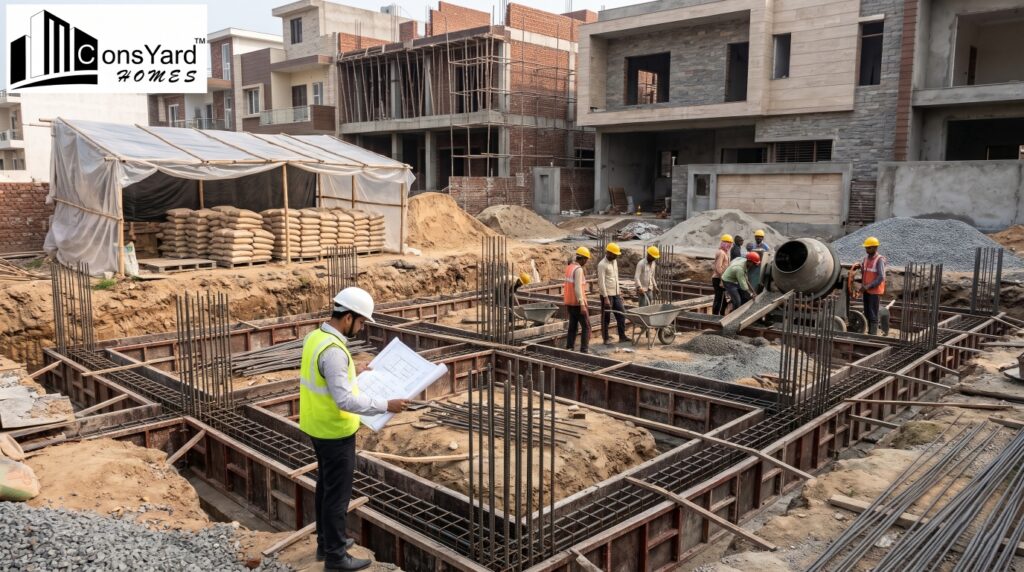
The foundation is one of the most critical stages of house construction.
Concrete used in foundation elements may include:
- Footings
- Foundation beams
- Columns
- Raft foundations where specified
- Other structural elements
The cement used must be suitable for the specified concrete mix.
But foundation quality depends on much more than cement.
It also involves:
- Soil conditions
- Foundation design
- Reinforcement
- Aggregate quality
- Water-cement ratio
- Concrete placement
- Compaction
- Curing
- Workmanship
This is why house foundation construction in Gurgaon should be approached as an engineered process.
Cement Quality in Beam and Column Construction
Beams and columns are major structural components in many residential buildings.
Their construction involves several coordinated activities.
Structural Drawing
↓
Reinforcement Placement
↓
Formwork
↓
Inspection
↓
Concrete Placement
↓
Compaction
↓
Curing
Cement is one component of the concrete used in this process.
However, the final structural performance depends on the complete system being executed correctly.
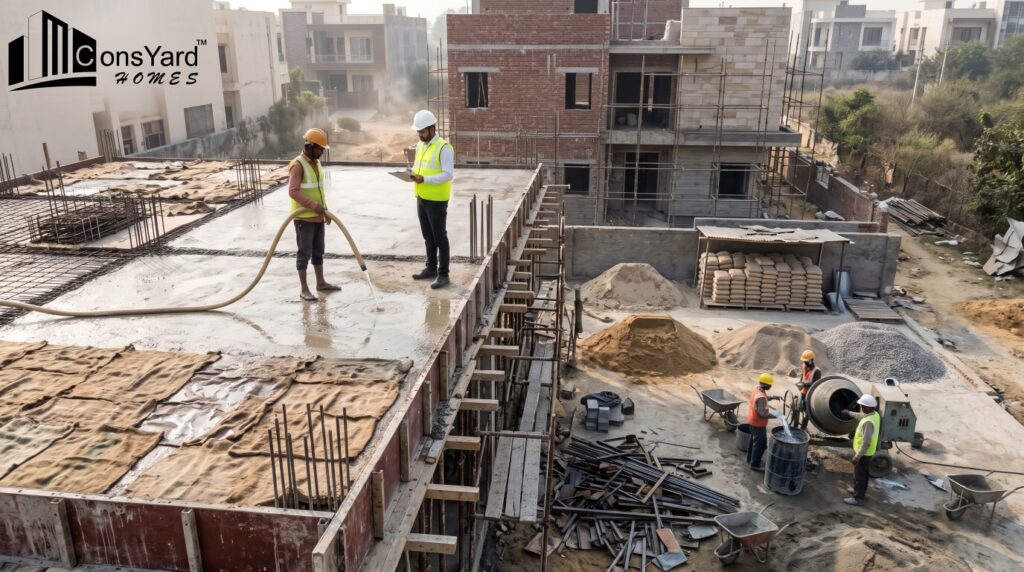
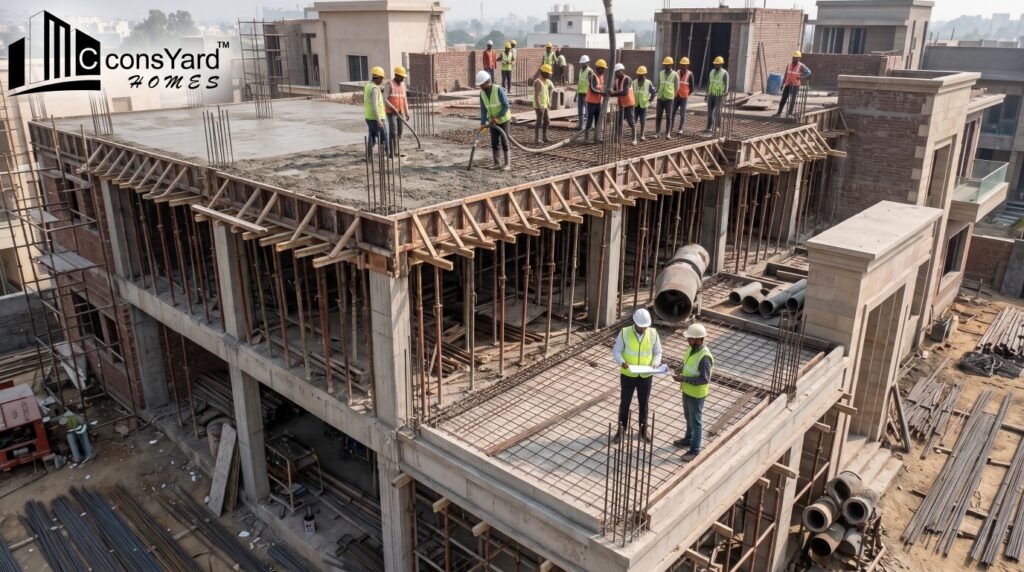
Cement and Slab Construction
Roof slabs and floor slabs require careful planning.
Important factors include:
- Concrete specification
- Reinforcement
- Formwork
- Concrete placement
- Compaction
- Level
- Curing
- Weather conditions
Poor curing or improper concrete practices can undermine the intended performance of the concrete even when good-quality cement was used.
Why Curing Is Important
Curing is one of the most overlooked aspects of residential construction.
After concrete is placed, it needs appropriate conditions for cement hydration and strength development.
Proper curing helps:
- Support strength development
- Reduce excessive moisture loss
- Improve durability
- Reduce the risk of certain shrinkage-related problems
The exact curing method and duration depend on the concrete, environmental conditions, element and applicable requirements.
This is why curing process in concrete should be treated as an important construction activity, not something that can be skipped once the concrete has been placed.
Cement Quality and Water-Cement Ratio
One of the most important concepts in concrete is the relationship between water and cement.
Adding more water does not simply make concrete “better to work with.”
Excess water can affect concrete properties.
A simplified relationship is:
Water-Cement Ratio = Weight of Water ÷ Weight of Cement
The required ratio should be established according to the concrete specification and design requirements.
The construction team should not add water casually to make concrete easier to place.
Can You Test Cement Quality at Home?
Some traditional site checks are sometimes discussed, such as:
- Checking for lumps
- Feeling the cement texture
- Observing colour
- Looking at storage condition
These can provide basic observations, but they cannot replace proper laboratory testing or quality documentation.
For important structural work, material quality should be controlled through appropriate procurement, testing and project specifications.
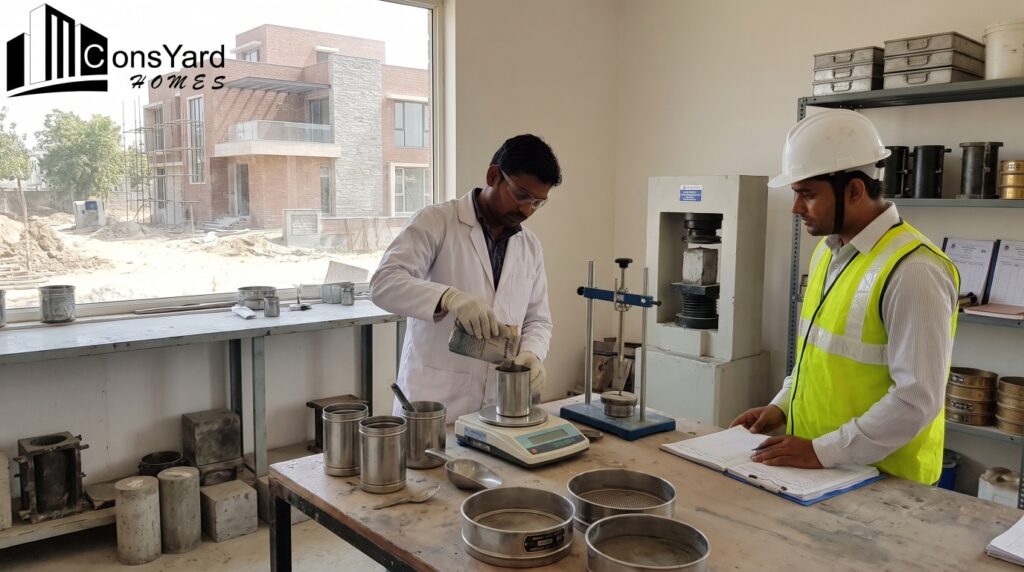
Laboratory Testing of Cement
Depending on the project requirements, cement can be evaluated through standardized tests.
These can include tests related to:
- Fineness
- Consistency
- Setting time
- Soundness
- Compressive strength
- Other applicable characteristics
The exact testing requirements should follow the relevant standards and project specifications.
For a homeowner, the important point is simple:
Do not rely entirely on visual inspection when quality verification is required.
What Should Homeowners Ask Their Construction Company?
You do not need to be a civil engineer to ask meaningful questions.
Before construction begins, you can ask:
Cement & Material Questions
- Which cement type is specified for the project?
- Is the product compliant with applicable standards?
- How will cement be stored on-site?
- How will incoming material be checked?
- What happens if damaged or moisture-affected material arrives?
- Is material procurement documented?
- What quality checks are performed during concrete work?
These questions can help you understand how seriously material management is being handled.
Cement Selection: Homeowner Checklist
| Check | What to Look For |
| Product | Appropriate cement type |
| Packaging | Properly sealed and identifiable |
| Date | Manufacturing information |
| Condition | No significant moisture damage |
| Storage | Dry and protected |
| Specification | Consistent with structural requirements |
| Testing | Appropriate quality verification |
| Procurement | Reliable source |
| Usage | Correct application |
| Curing | Proper post-placement practice |
Common Mistakes Related to Cement
Mistake 1: Choosing Only by Brand
A recognized brand is useful, but brand name alone does not replace correct specification and workmanship.
Mistake 2: Buying Excessive Stock
Large quantities should not be stored without considering project consumption and storage conditions.
Mistake 3: Ignoring Storage
Even good cement can be affected by moisture.
Mistake 4: Using Moisture-Damaged Cement
Hardened or significantly affected material should not automatically be treated as normal cement.
Mistake 5: Adding Water Without Control
Extra water can alter the intended concrete mix.
Mistake 6: Ignoring Curing
Concrete work does not end when the concrete is poured.
Mistake 7: Focusing on Cement Alone
Aggregate, water, mix design, reinforcement, compaction, curing and workmanship also matter.
Cement Quality vs Overall Construction Quality
A useful way to understand residential construction is to look at the complete picture.
| Construction Factor | Importance |
| Cement quality | Important |
| Steel/reinforcement quality | Important |
| Aggregate quality | Important |
| Structural design | Critical |
| Foundation design | Critical |
| Concrete mix | Critical |
| Workmanship | Critical |
| Compaction | Important |
| Curing | Critical |
| Waterproofing | Important |
| Quality supervision | Important |
A strong home is the result of multiple correctly coordinated components, not one material.
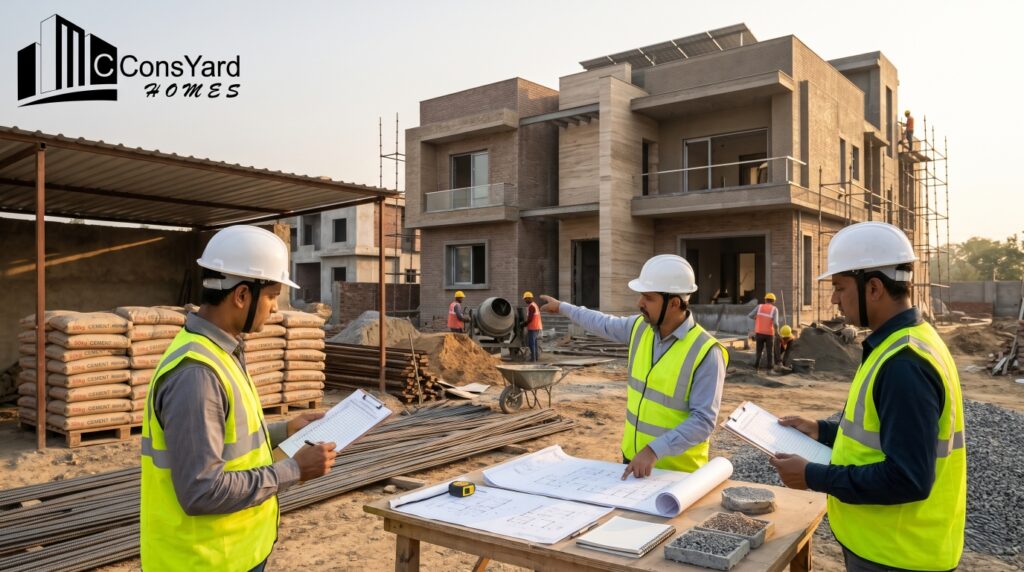
How a Professional Construction Company Manages Cement
A structured construction company should have a process for:
Material Selection
↓
Procurement
↓
Delivery
↓
Inspection
↓
Storage
↓
Controlled Usage
↓
Construction
↓
Quality Checks
This approach can help reduce unnecessary material wastage and improve consistency across the project.
Cement Quality During Residential Construction in Gurgaon
Gurgaon and Gurugram have a wide range of residential construction projects, from independent homes and duplexes to larger premium residences.
The construction requirements can vary depending on:
- Plot
- Building size
- Number of floors
- Structural system
- Soil conditions
- Design
- Exposure conditions
- Finishing requirements
Therefore, cement and other construction materials should be selected as part of the project’s overall technical requirements.
Consyard Homes: Building With Attention to the Details
At Consyard Homes, residential construction is approached as a complete process rather than a collection of individual tasks.
Our construction scope can include:
- Architectural planning
- Floor plan design
- 3D visualization
- Structural design
- Foundation construction
- RCC structure
- Civil construction
- Electrical work
- Plumbing
- Waterproofing
- Flooring
- Painting
- Finishing
- Project coordination
- Final handover
With 25+ years of experience and 500+ completed projects, Consyard Homes works with homeowners in Gurgaon, Gurugram, Manesar and selected areas of Delhi NCR.
The focus is on coordinating design, materials, engineering and execution so that important details are considered throughout the construction process.
Cement Is Only One Part of a Strong Home
When homeowners think about construction quality, it is natural to focus on the materials.
But a durable home requires more than good cement.
It requires:
Good Design
+
Correct Materials
+
Proper Structural Engineering
+
Skilled Workmanship
+
Quality Control
+
Correct Construction Practices
+
Proper Curing and Protection
Together, these elements contribute to the quality and performance of the completed building.
Frequently Asked Questions About Cement Quality
Which cement is best for house construction?
There is no universally best cement for every house. The appropriate type should be selected according to structural requirements, applicable standards, concrete specifications and construction conditions.
How can I check cement quality?
Check the product information, packaging, manufacturing details, storage condition and visible signs of moisture damage. Where required, proper testing should be used rather than relying only on visual inspection.
Can old cement be used for construction?
Cement can be affected by age and storage conditions, especially when exposed to moisture. Older material should be evaluated according to its condition and applicable quality requirements before use.
Is OPC better than PPC?
Neither should be considered universally better. OPC and PPC have different characteristics, and the appropriate choice depends on the project requirements and specifications.
Why is cement storage important?
Cement can be affected by moisture. Proper dry storage helps protect the material until it is used.
Does good cement guarantee a strong house?
No. Cement is only one component. Structural design, reinforcement, aggregates, water, concrete mix, workmanship, compaction and curing all contribute to construction quality.
Is cement used only for RCC work?
No. Cement can also be used in mortar, plastering, screeds and other construction applications depending on the project.
Final Thoughts
Cement quality in construction is important, but it should always be viewed as part of a larger construction system.
For homeowners building in Gurgaon or Gurugram, the better question is not simply:
“Which cement brand should I buy?”
It is:
“Are the right materials being selected, stored, tested and used correctly according to the project’s engineering requirements?”
That shift in thinking can help homeowners understand construction quality more realistically.
A strong home begins with good planning and continues with proper engineering, suitable materials, skilled execution and consistent quality control at every stage.
If you are planning house construction in Gurgaon, Gurugram or Manesar, Consyard Homes can help coordinate the process from architectural planning and structural design to construction, finishing and handover.
Don’t Leave Your Gurgaon Home’s Strength to Chance
Premium cement alone won’t protect your family in Seismic Zone 4 if site contractors water down the mix or skip curing[cite: 1, 2]. Build your Stilt + 3 or Stilt + 4 residence with institutional engineering supervision, zero hidden costs, and verified structural testing at every stage[cite: 1, 2].